

Have you heard of a temple deity said to breathe like a living being? That’s exactly what draws pilgrims up the hill at Malluru Narasimha Swamy Temple. Tucked away in Telangana’s forests, this hilltop shrine is one of the state’s most talked-about spiritual destinations.
Also known as Hemachala Narasimha Swamy Temple and Hemachala Lakshmi Narasimha Swamy Temple, it sits on Puttakonda hill in Mallur village. If you’re planning the trip, here’s everything you need , from the Malluru Narasimha Swamy Temple distance from major cities to timings, legends, and nearby attractions.
About Malluru Narasimha Swamy Temple
Malluru Narasimha Swamy Temple is a hilltop shrine dedicated to Lord Narasimha, the fierce Narasimha avatar and Lord Vishnu incarnation. It’s counted among the more mysterious Telangana temples, largely due to the unusual features of its deity, which many devotees regard as a real Narasimha Swamy presence rather than just a carved idol.
The temple stands on Puttakonda hill, about 1,500 feet above sea level, surrounded by dense forest. Reaching it means climbing a stretch of stone steps through this forest temple setting, which itself is part of the pilgrimage experience.
Location and How to Identify the Temple
The temple is officially known as Sri Hemachala Lakshmi Narsimha Swamy Deval and is located in Mallur village, Mangapet Mandal, Jayashankar Bhupalpally district, Telangana (older records also list it under the erstwhile Warangal district). It’s close to the Eturunagaram–Bhadrachalam highway, about 4 km into the forest from Mangapet.
| Detail | Information |
| Village | Mallur |
| Mandal | Mangapet |
| District | Jayashankar Bhupalpally |
| State | Telangana |
| Altitude | ~1,500 ft (Puttakonda hill) |
History of Malluru Narasimha Swamy Temple
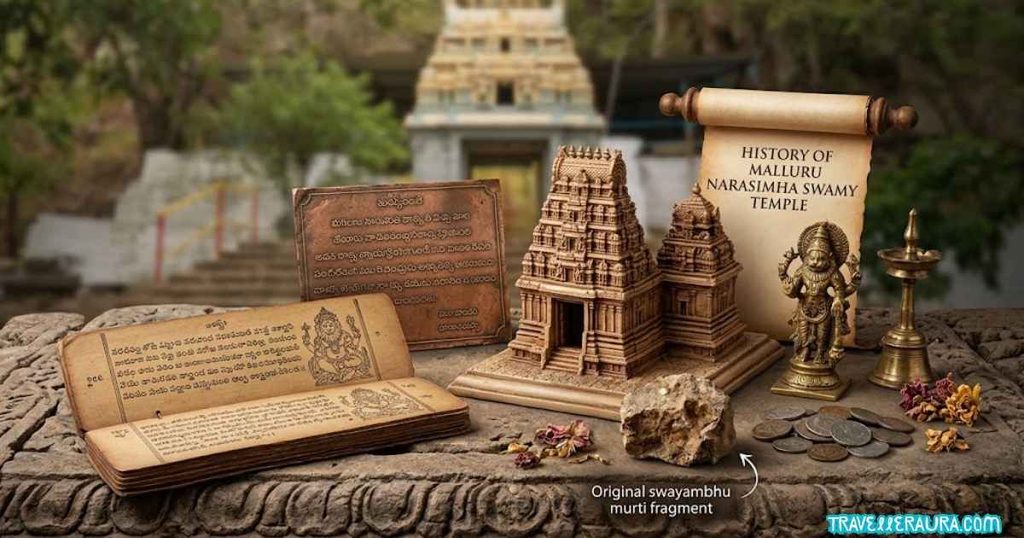
The history of Malluru temple is layered with legend as much as recorded fact. Local tradition holds the site to be around 4,776 years old, tied to events from the Ramayana era, while at least one record attributes the temple’s construction to Chola-era rulers between 1010–1200 CE. Given this gap, it’s best treated as an ancient temple Telangana with a long, evolving oral history rather than a single confirmed date.
The temple carries deep religious significance as a site connected to Lord Rama, and separately, to Kakatiya-period queen Rani Rudramadevi. Its mythological significance is one reason it continues to draw devotees from across the region.
Legend of Agastya and Ravana’s Gift
According to legend, Sage Agastya is credited with naming the hill “Hemachala.” Local mythology also says that Ravana gifted this land to his sister Shurpanaka, and that this is where Lord Rama and Khara Dushana’s forces clashed, with Rama defeating the demon army stationed here.
Architecture and the Swayambhu Deity
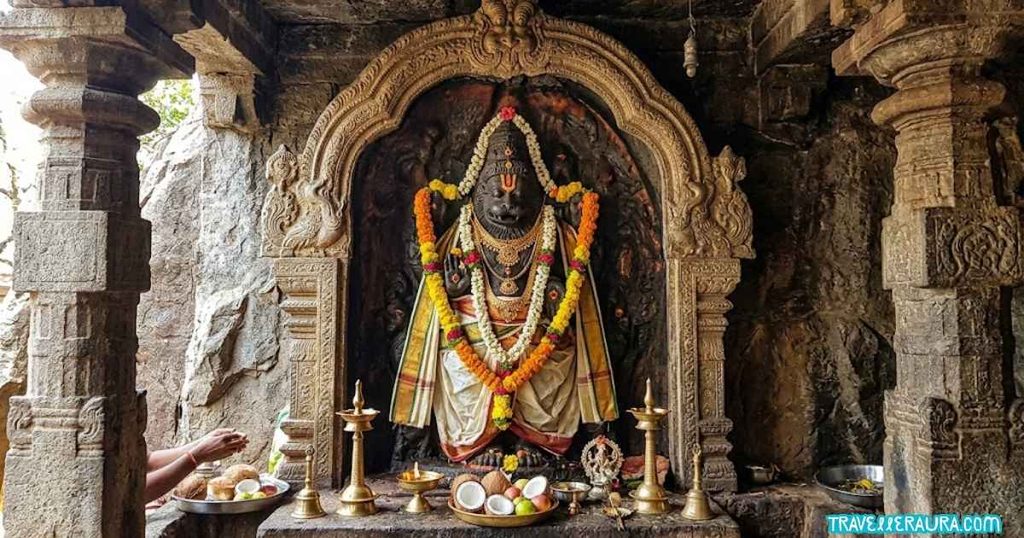
The temple is built into the hillside rather than as a freestanding structure, giving it the character of a hillside shrine shaped by the surrounding rock. Its most notable feature is that the main idol is considered a Swayambhu deity , self-manifested rather than sculpted by human hands.
A dwajasthambham (flag pillar) at the site is reported to stand around 60 feet tall, and near the temple stands a rock-formed Anjaneya Swamy statue, said to be one of the first of its kind in South India.
Unique Features of the Narasimha Idol
The Narasimha Swamy idol here is widely described as having hair on its chest, unusual for a stone idol, which contributes to the belief that it resembles a living being. Devotees also report that touching the idol’s chest causes a finger to sink in slightly, as though into skin rather than rock.
Reported idol height varies between sources (approximately 9.2 to 10 feet), so treat the exact figure as approximate. The idol is also associated with Chandana Dhravam, a moisture said to emerge near the navel, regarded by devotees as a holy theertham.
Malluru Narasimha Swamy Temple Timings
Malluru Narasimha Swamy temple timings are generally split into a morning and evening session, with a midday closure. Some sources list a single 8 AM–5 PM window instead, so it’s worth confirming locally, especially around festival dates.
| Session | Timing |
| Morning darshan | 8:00 AM – 1:00 PM |
| Afternoon break | 1:00 PM – 3:00 PM |
| Evening darshan | 3:00 PM – 5:00 PM |
Note: Timings may change on festival days , verify locally before traveling.
Darshan Duration and Puja Schedule
A typical darshan at the temple takes around 20–30 minutes under normal, non-festival conditions. Specific daily puja/seva schedules are not consistently documented across sources, so it’s best to check with the temple administration on arrival.
Ticket Price and Entry Fee
Multiple sources indicate free darshan with no entry fee for general devotees. However, we could not confirm current details on VIP darshan, special seva charges, or online booking availability from reliable, up-to-date sources , please verify these directly with the temple authorities before your visit rather than relying on older listings.
The Sacred Chintamani Jalapatham Waterfall
Chintamani Jalapatham, also called Chintamani waterfall, is a spiritual healing stream believed to flow continuously near the temple, its source considered a mystery by locals. It’s one of the most talked-about elements of a Malluru pilgrimage, alongside the temple itself.
Devotees regard this as sacred waterfall in Telangana territory, collecting the water , sometimes locally referred to as Akka Dhaara Chelli Dhaara , believing it carries healing properties drawn from the surrounding medicinal plant water sources in the forest.
Legend of Rani Rudramadevi’s Cure
As the story goes, Kakatiya queen Rani Rudramadevi once suffered a serious illness and was cured after drinking water from this stream. Since then, the healing water legend has stayed attached to the site, with devotees continuing to carry the water home, even sending it to relatives abroad.
Malluru Narasimha Swamy Temple Steps
Reaching the shrine involves climbing steps to temple grounds cut into the hillside. Reported step counts vary , some sources cite 74–76 steps, while others mention a longer climb of around 120–150 steps , so expect a moderate uphill walk rather than a short flight.
Given the trekking to hilltop temple involved, comfortable footwear is recommended, and total visit duration (climb plus darshan) typically runs about an hour for most visitors.
How to Reach Malluru Narasimha Swamy Temple
Knowing how to reach Malluru Narasimha Swamy Temple in advance matters, since it’s set deep inside a forest area away from major transit hubs. Below is a breakdown by transport mode.
By Road
The temple is accessible via the Eturunagaram–Bhadrachalam highway, with the turn-off near Mangapet village, about 4 km from the temple. APSRTC buses run between Bhadrachalam and Hanumakonda via Eturunagaram and Manuguru, with a stop at Mangapet; from there, autos or private vehicles cover the final stretch.
By Rail
Government tourism records list Warangal railway station as the nearest major rail connection, though other sources mention Manuguru railway station as a closer alternative , confirm current train connectivity before planning your route, since the two differ significantly in distance.
By Air
The nearest airport is Rajiv Gandhi International Airport, Shamshabad, in Hyderabad, roughly 300 km from the temple. From there, road transport is required for the rest of the journey.
Distance from Major Cities (Table)
| Starting Point | Distance | Travel Option |
| Bhadrachalam to Malluru Narasimha Swamy Temple | ~88–90 km | Road |
| Warangal | ~129–132 km | Road/Rail + Road |
| Hyderabad (via Shamshabad Airport) | ~300 km | Air + Road |
| Mangapet village | ~4 km | Road |
Malluru Narasimha Swamy Temple distance from my location will vary , use the nearest reference point above (Bhadrachalam, Warangal, or Hyderabad) to estimate your own route.
Best Time to Visit Malluru Temple

The best time to visit Malluru temple is between October and June, when the weather is more manageable for the forest climb and darshan queues are shorter outside festival season. Summers can get intensely hot in this part of Telangana, so early morning visits are advisable if traveling in peak summer.
Vaishaka Masam (April–May) is the most vibrant , and most crowded , period, coinciding with the temple’s main Brahmotsavam celebrations.
Festivals Celebrated at the Temple
The temple’s festival calendar includes several major observances tied to the Narasimha avatar and the broader Vaishnavite calendar.
- Narasimha Jayanthi
- Vaikunta Ekadashi
- Sri Brahmotsavam (during Vaishaka Masam, April–May)
Expect larger crowds and possible timing changes during these periods , check locally before planning a festival-season visit.
Nearby Places to Visit
A trip here pairs well with several other attractions in the Mulugu/Bhupalpally forest belt, making it easy to build a short regional itinerary around temples, lakes, and waterfalls.
| Nearby Place | Why Visit |
| Mallur Gutta Fort | Ancient Satavahana-era fort wall nearby |
| Pandavula Guhalu | Rock-cut caves with historic interest |
| Ramappa Lake & Ramappa Temple | UNESCO heritage temple tour extension |
| Laknavaram Lake | Scenic lake, popular day-trip spot |
| Bogatha Waterfall | Well-known regional waterfall |
| Sammakka Saralamma Temple | Major tribal pilgrimage site |
| Sri Ramlingeswara Swamy Temple | Nearby Shiva temple |
Mallur Gutta Fort , Ancient Satavahana Wall
Close to the temple lies Mallur Gutta Fort, an extensive Satavahana-period fort wall reported to span roughly an 8 km radius , larger than the Warangal and Golconda forts. It’s a worthwhile add-on for travelers interested in combining temple visits with Telangana temples’ surrounding history.
Parking, Dress Code and Visitor Rules
As with most hillside pilgrimage sites, parking facilities exist at the base of the climb, though current fee details aren’t consistently confirmed across sources , check on arrival. Traditional attire is generally recommended for temple entry, in keeping with standard dress code norms at Telangana temples.
- Traditional/modest clothing recommended
- Footwear typically left at the base before the climb
- Photography rules inside the sanctum should be confirmed on-site, as policies can change
- Expect queue-based entry during festival periods
What to Carry for Your Visit
Given the forest trail and step climb, a few practical items make the visit smoother.
- Comfortable walking shoes for the steps
- Drinking water for the climb
- A change of footwear-friendly clothing for the trek
- Cash, since digital payment options may be limited in this remote forest temple location
- A small bag for carrying Chintamani Jalapatham water, if you plan to collect any
Accommodation and Food Near the Temple
We couldn’t confirm specific dharamshala, guest house, or hotel details directly at the temple site from reliable sources; most pilgrims currently base themselves in nearby towns like Bhadrachalam, Mangapet, or Warangal and visit as a day trip. Similarly, dedicated food stalls at the temple itself aren’t well documented, so carrying your own water and snacks is a safer bet, with more dining options available once you’re back on the main highway route.
Travel Tips for First-Time Visitors
- Start early in the day to avoid the afternoon heat during the climb
- Confirm current timings and any festival-day changes before you set out, since schedules can shift
- Carry cash, as facilities in this forest temple location are limited
- Wear sturdy, comfortable footwear for the steps
- Combine the trip with nearby attractions like Ramappa Temple or Laknavaram Lake to make the most of the journey
- Respect local customs and any photography restrictions inside the sanctum
Read more:
Ross Hill Church A Timeless Symbol of Faith in Visakhapatnam
Snow World Hyderabad: A Complete Guide for Your Visit
Ratnalayam Temple Guide: Timings, Location & Travel Tips
Frequently Asked Questions
What is the history of Mallur temple?
The temple’s history blends legend and record , some traditions date it to over 4,776 years ago, tied to Ramayana-era events, while other accounts link its structure to Chola-period construction.
Which is the most powerful Narasimha temple?
This varies by devotee belief and region; Malluru Narasimha Swamy Temple is regarded as significant for its Swayambhu deity and unusual, lifelike idol features.
How far is the Malluru Narasimha Swamy Temple from Hyderabad?
It’s roughly 300 km from Hyderabad, primarily measured via the route through Rajiv Gandhi International Airport, Shamshabad.
What are the timings for the Malluru Laxmi Narasimha Swamy Temple?
Most sources list 8:00 AM–1:00 PM and 3:00 PM–5:00 PM, though some cite a single 8 AM–5 PM window , confirm locally before visiting.
Which day is good for Narasimha Swamy?
Saturdays are traditionally considered auspicious for Narasimha worship in general Vaishnavite practice, though no temple-specific day is documented for Malluru.
When to visit Lakshmi Narasimha Swamy Temple?
October to June is ideal for pleasant weather, with Vaishaka Masam (April–May) being the most festive but also the most crowded period.
Conclusion
Malluru Narasimha Swamy Temple offers a rare mix of natural setting, legend, and an idol devotees consider genuinely alive. Between the forest climb, the Chintamani Jalapatham, and nearby sites like Mallur Gutta Fort, it makes for a full day of travel rather than a quick stop.
Plan around the October–June window, confirm timings before you leave, and pair the visit with Ramappa Temple or Laknavaram Lake nearby. For anyone exploring Telangana’s lesser-known pilgrimage circuit, this hilltop shrine is well worth the climb.

I’m the creator of TravellerAura.com ; a travel blog dedicated to inspiring journeys, practical tips and unforgettable destinations around the globe.
